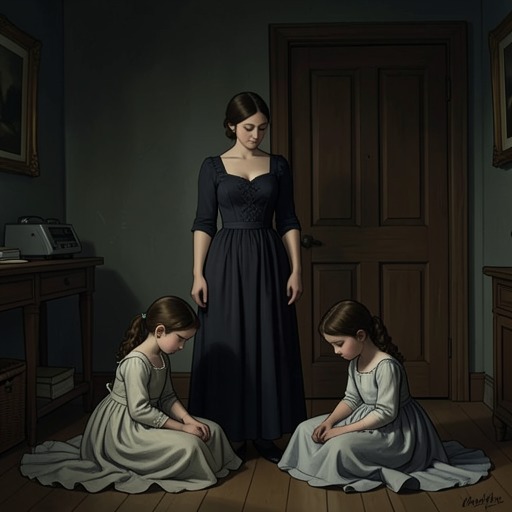
Baby Kochamma’s false accusation against Velutha
The God of Small ThingsBaby Kochamma’s false accusation against Velutha is the decisive conversion of a concealed relationship into a police case against a worker. At the Kottayam police station, she presents Velutha as a threat to the family, while the truth she suppresses is that Ammu and Velutha’s relationship was consensual. Her account does more than misstate events: by framing them for Inspector Thomas Mathew, she helps make the family’s version the basis for official action against Velutha.
The accusation and its purpose
Baby Kochamma is ushered, shaking, into Inspector Thomas Mathew’s room and explains the circumstances behind a factory worker’s sudden dismissal. She identifies Velutha as a Paravan and alleges that he tried to force himself on her niece, a divorced woman with two children. Her version recasts the relationship between Ammu and Velutha as an assault. The accusation is false, but it is delivered within a setting where the family’s standing and Velutha’s caste shape how the allegation will be heard.
The account serves Baby Kochamma’s effort to contain scandal and preserve the family’s reputation in the Inspector’s eyes, not to defend Ammu. She does not anticipate that Ammu will later go to the police and try to correct the record. As Baby Kochamma tells the story, she begins to believe it herself. That detail makes the lie more than a calculated statement: its repetition begins to blur, for its teller, the boundary between the account she constructs and the facts she has concealed.
Constructing a convincing story
Baby Kochamma gives the Inspector a detailed setting for the alleged threat. She says it was around seven the previous evening, during heavy rain, after the lights had gone out and the women were lighting lamps. Chacko was away in Cochin, she claims, leaving three women alone in the house. These circumstances invite the Inspector to imagine danger before she has established her allegation; the scene is built to make her account feel plausible through its particulars.
She further claims that the family told Velutha to leave Ayemenem quietly or they would call the police. In her telling, he answered that Ammu had consented, challenged the evidence against him, and invoked labor laws as grounds against his dismissal. She presents him as calm but insolent, and describes his words as evidence of a lack of remorse. Her performance shifts the emphasis from what he allegedly said to the manner she assigns to him, making defiance itself appear incriminating.
The narration marks a consequential omission. Baby Kochamma does not tell the Inspector that Mammachi had lost control, gone up to Velutha, spat in his face, and insulted him. Instead, she transfers to Velutha a posture of sneering fury and insolence associated with a man who had humiliated her during the march. She then connects the supposed threat to the children’s disappearance, suggesting the dismissal and their absence cannot be unrelated. The accusation thus absorbs separate anxieties into one story of danger.
Family authority, caste, and political calculation
To establish her family’s claim over Velutha, Baby Kochamma says that she has known him since he was a child, that her family educated him at the school for Untouchables founded by her father, Punnyan Kunju, trained him as a carpenter, and provided his grandfather’s house. Her inventory of supposed obligations presents his independence as ingratitude. The family’s past assistance, as she frames it, becomes a claim to authority over the worker rather than evidence of a relationship in which he can act on his own terms.
Inspector Thomas Mathew answers that the family had spoiled such people, carried them about like trophies, and then sought police help when they misbehaved. His response acknowledges the family’s paternalistic role without rejecting its account or offering Velutha protection. Baby Kochamma lowers her eyes, then adds that she had noticed signs of insolence and mentions seeing him in the march toward Cochin and hearing rumors that he was or had been a Naxalite. She also invokes a dead child and two missing children, joining political suspicion and family grief to the sexual accusation.
The Inspector records her account in a First Information Report and assures her that the Kottayam Police will cooperate and catch Velutha before the day is out. Yet he also takes a political precaution: he sends a jeep to fetch Comrade K. N. M. Pillai, wanting to know whether Velutha has political backing or is acting alone. Though a Congress man, the Inspector does not want to risk a confrontation with the Marxist government. The case is therefore shaped not only by Baby Kochamma’s testimony but also by the state’s calculation about local political power.
The official account and its consequences
Comrade K. N. M. Pillai tells the Inspector that he knows Velutha but omits that Velutha is a Communist Party member and that he had come to Pillai’s door late the previous night. Pillai, the last person known to have seen Velutha before he disappeared, also does not challenge the attempted-rape allegation, though he knows it is untrue. Instead, he assures the Inspector that Velutha lacks the party’s protection and is on his own. His silence leaves Baby Kochamma’s account unopposed at the point when political support might have altered the authorities’ response.
The novel places this accusation within a broader account of power: what the twins witness that morning is described as a demonstration of human beings’ pursuit of ascendancy, structure, order, and monopoly, with history acting under the guise of divine purpose. The framing resists treating the events as accidental or as a private settling of scores. Baby Kochamma’s accusation is one link in that process: a family’s false story enters police procedure, political calculation leaves Velutha isolated, and the resulting official account helps determine what can be done to him.
The later scene at the police station exposes the cost of the version Baby Kochamma has helped establish. When the Inspector asks Estha whether Velutha is the man, Estha answers yes. That coerced identification does not make the accusation true; instead, it shows how the earlier false account and the power of the police converge on a child’s confirmation. The accusation’s significance lies in that progression from fabricated testimony to official action, and in the way caste and institutional authority make the false version consequential.